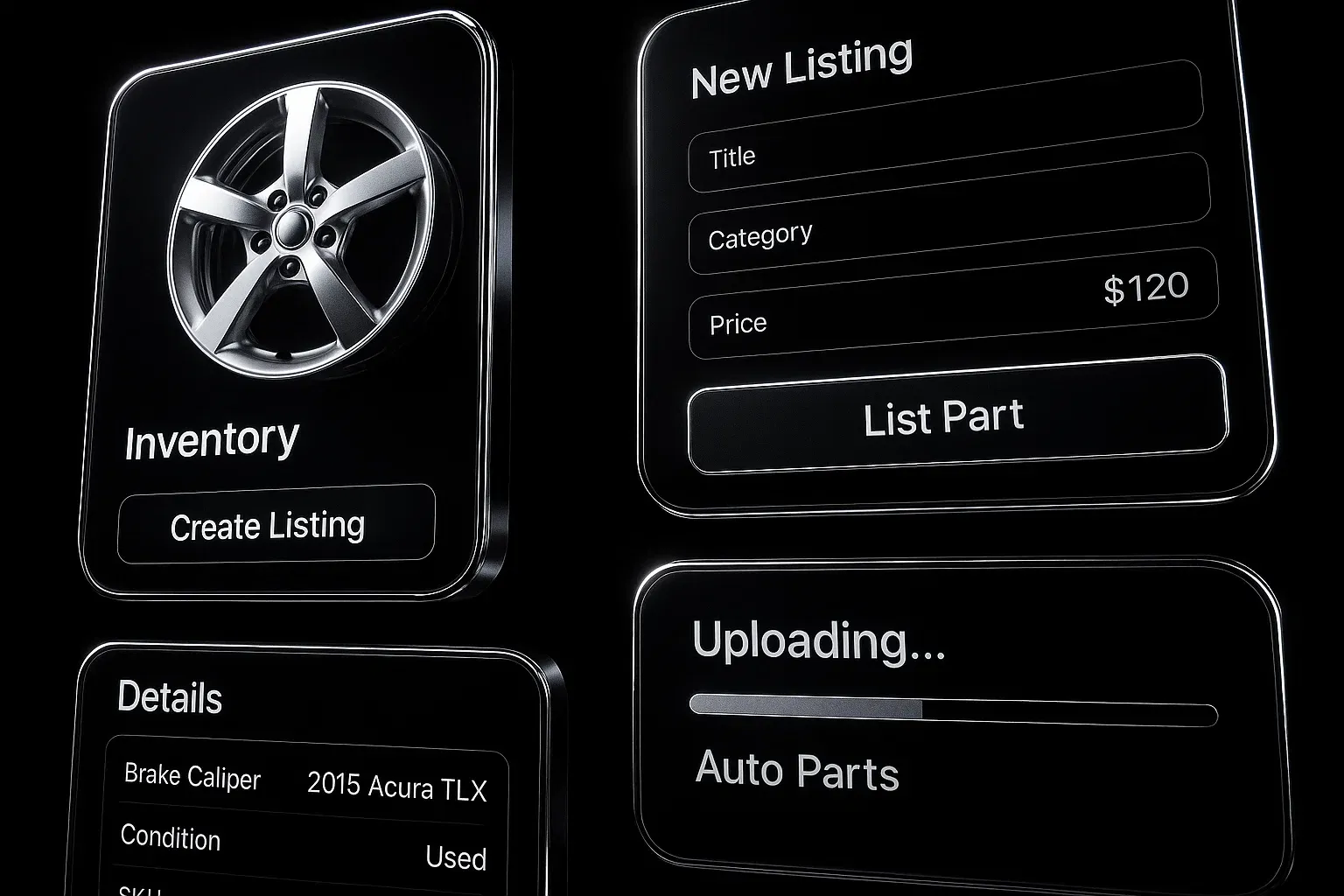
Why Every Auto Parts Business Should Be Selling on eBay in 2025 (Real Market Insights)
Auto parts are now eBay’s number one sales category. Learn why every auto parts business, retailer, warehouse, and junkyard should be selling on eBay in 2025, and how to start the right way.

Updated Dec 18, 2025
|Jack Blum
Why Auto Parts Businesses Need to Sell on eBay in 2025
Picture your warehouse on a Tuesday afternoon. Shelves are full, pallets are wrapped, and part numbers are everywhere. But the phone is quiet, walk-in traffic is slower than last year, and your best counter person is spending more time chatting than invoicing. The stock is there, the demand for repairs is there, and yet the money feels stuck on your shelves.
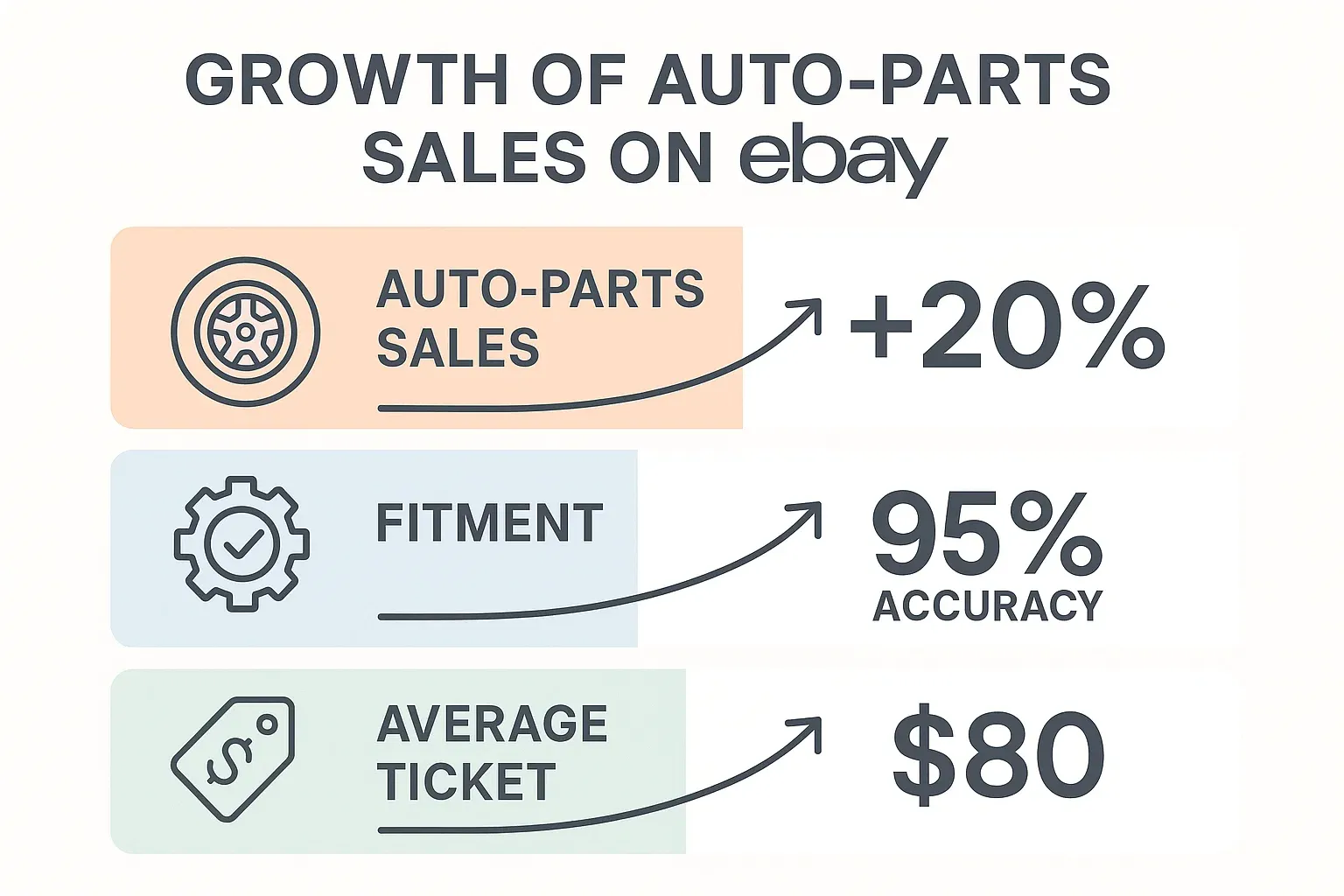
At the same time, eBay Motors and its Parts & Accessories segment are generating massive sales volume, with parts and accessories sold every second in the United States. Automotive has become eBay’s number one sales category by volume and revenue. The blunt truth is simple: if you sell car parts and you are not on eBay, you are leaving money on the table.
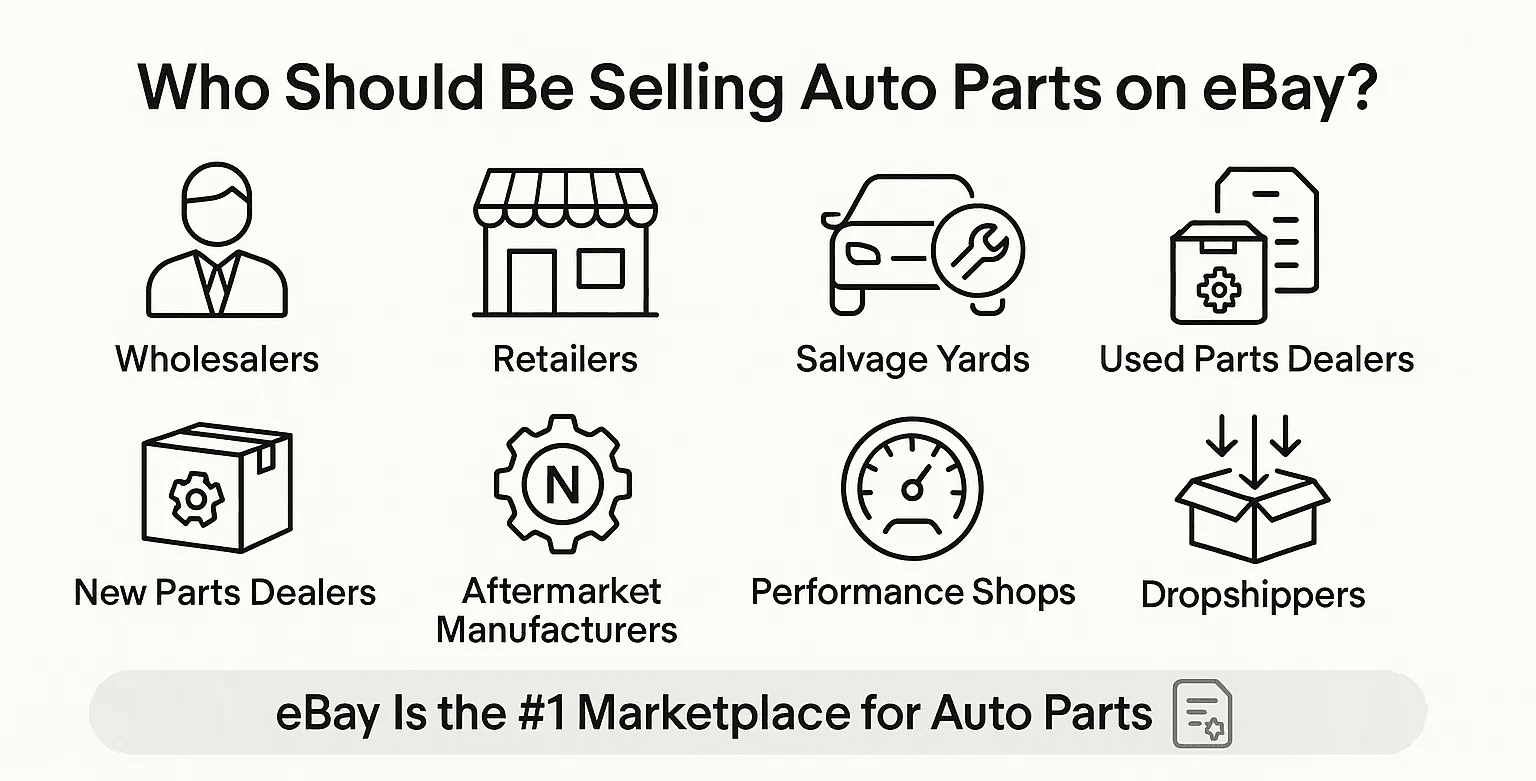
Whether you are a wholesaler, retailer, manufacturer, salvage yard, used parts dealer, new parts dealer, aftermarket specialist, or even a dropshipper, you should, and in 2025 arguably must, be selling on eBay.
This article is for auto parts businesses that have never sold on eBay and are looking for their next serious growth channel for their business. If you are already selling auto parts on eBay and want to improve your results, start with our guide How to Get More People to View Your eBay Listing and consider completing our Store Assessment for a detailed look at where your store can grow.

The Market Shift In How Buyers Shop For Auto Parts
Your customers have changed more than your inventory has. Mechanics, DIYers, used car dealers, and performance enthusiasts increasingly start on their phone, not at the counter. They search by exact part numbers, vehicle plus year and engine, VIN, or simple “fits my vehicle” queries. They expect fast shipping, clear fitment information, and the ability to compare options side by side.
eBay has leaned into that behavior. eBay Motors now hosts a huge catalog of parts and accessories and has trained buyers to enter their vehicle details first, then browse only the compatible inventory. Many buyers no longer think in terms of which local store to call. Their default question is which marketplace shows the right part at the right price. If your parts are not there, they never even know you exist.
Is there still room for a small or mid-sized auto parts business to succeed on eBay in 2025?
There is more competition than five years ago, but auto parts are still the number one category on eBay, with billions in annual sales. The real gap is not in being first, it is in doing the basics better than the average seller: clean fitment data, competitive pricing, reliable shipping, and consistent automation. Most warehouses and yards are not even on eBay yet, so your biggest advantage is simply showing up with professional listings and systems that scale.
Why eBay Is The Number One Marketplace For Car Parts?
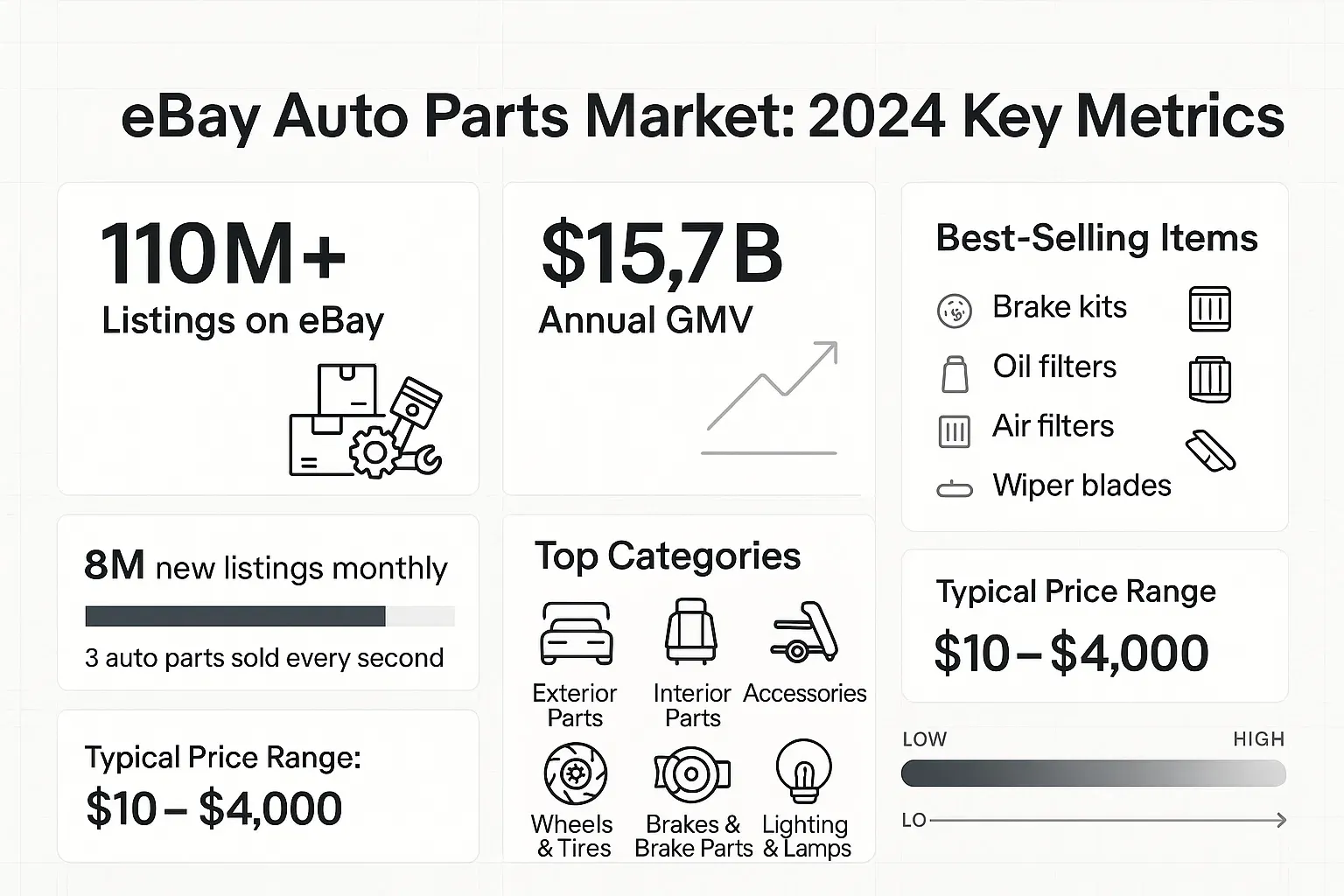
There are many places to sell online, but for auto parts, eBay operates in its own league. Automotive is the platform’s top category, and car parts generate massive GMV every year. The marketplace is so dominant in this niche that even giants like Amazon and Walmart have been forced to invest more heavily in automotive and vehicle fitment tools to try to catch up. If you are thinking that everyone sells on Amazon now, remember that for car parts specifically, eBay has been building this category for decades.
What makes eBay uniquely powerful is its ability to handle the real-world complexity of parts. You can sell new parts, used parts, OEM surplus, refurbished components, and even “for parts or not working” units that still have value. The fitment system lets buyers filter by year, make, model, engine, and other specifics, so they feel confident that the part they are buying will actually fit. Buyers are trained to think of eBay as the place to find hard-to-get, no longer available, off the dealer’s radar parts, or anything else, often at competitive pricing.
That means your full engine block, your bare body shell, your stack of tires, and even your specialized tools have a natural home on eBay. Someone, somewhere, is likely already searching for them. If you are not there, that buyer will simply spend money with the sellers who are.
If you want to see the size of the auto parts category for yourself, eBay maintains a dedicated marketplace section for every major automotive part, accessory, and fitment category. You can browse the live listings and category structure here:
https://www.ebay.com/b/Auto-Parts-and-Vehicles/6000/bn_1865334
What Happens If You Stay Offline And Local...
This part is uncomfortable but necessary. Many auto parts businesses still depend almost entirely on local walk-ins, phone orders, and a handful of trade accounts. They might also have an old website that looks fine on a desktop computer but is unusable on a phone. That model worked for decades, and it still works to a point, but the direction of the market is clear.
If your business relies only on phone orders and local walk-ins, it is at real risk of disappearing sooner rather than later. Younger buyers and technicians default to their phones. Fleet owners and used car dealers price check online. Inflation and tighter budgets push consumers to hunt harder for value, so they are willing to buy from a seller in another state if the price and fitment look right. Meanwhile, the competitors who are listing online are quietly building feedback, ratings, and repeat customers that you never see.
At the same time, too many car parts sellers and junkyard owners are closing down and liquidating years of inventory for pennies on the dollar. Pallets of perfectly usable parts get sold off at scrap prices simply because the owner never built a direct channel to the people who need them. eBay does not automatically fix every problem, but it does give you something you do not have right now: access to global demand for the inventory already sitting on your racks.
AI Is Already Deciding Which Parts Business Wins
You have probably experienced this: you think about or talk about something, and not long after, you see an ad or a video about it on your phone. It feels like your phone is listening in on your conversations. In reality, most of this is not magic or microphones. It is AI-powered targeting. Ad platforms connect searches, clicks, app usage, locations, and browsing behavior, then use machine learning to decide which products and services to show you.
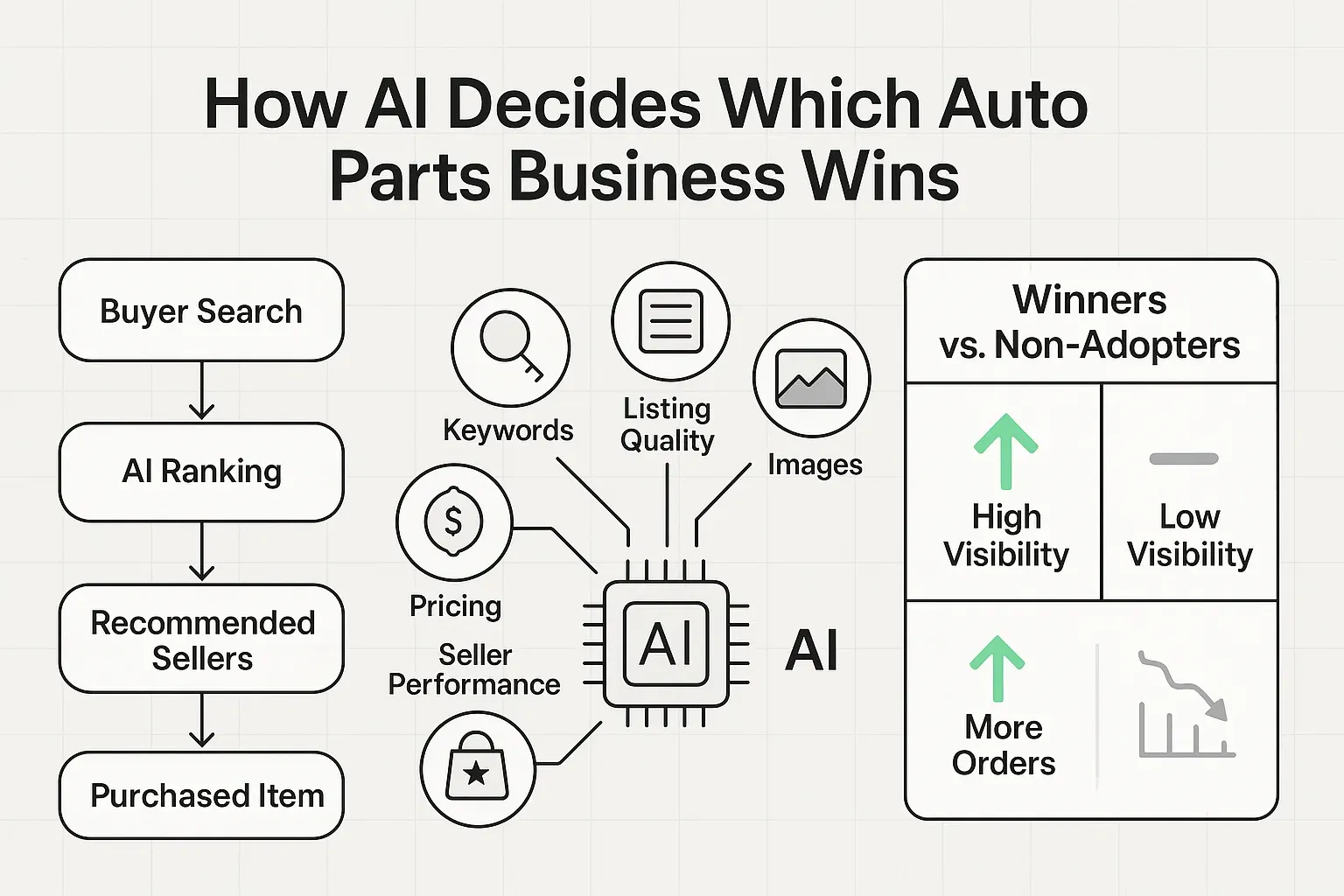
The critical point is that AI is already deciding which brands and sellers buyers see, long before the buyer even knows they need a part. If you are not in the digital ecosystem, you are invisible to those systems. Your inventory never shows up as a suggested product, never appears in a personalized feed, and never benefits from remarketing campaigns that follow a serious buyer across platforms.
Blockbuster, Party City, Bed Bath & Beyond, Toys “R” Us, Circuit City, and RadioShack, are just a few examples of once dominant retailers that relied heavily on local foot traffic and are now gone. If you want something closer to your industry, look at Advance Auto Parts, which recently announced the closure of hundreds of locations. Size did not save them. The only thing that separates the brands that survived from those that disappeared is how quickly they adapted to the market changes.
Marketplaces like eBay are also leaning heavily into AI-driven search, recommendations, and personalization. High-quality, well-structured listings tend to be favored, shown to more of the right buyers more often. That means the quality of your listing data and your willingness to plug into this ecosystem directly affect how many buyers ever see your stock. When people talk about the AI revolution as something coming in the future, the truth is that it is already shaping who grows and who quietly fades away.
Market Insights That Matter On The Shelf And Pallet Level
Let us translate all this into warehouse language: shelves, pallets, and SKUs. Auto parts and accessories generate billions of dollars in sales on eBay each year. A huge share of buyers on the platform purchase parts or accessories, and parts are moving constantly, not just in seasonal spikes. That means the global demand for what you sell does not live only in your city. It lives in thousands of shops, garages, and driveways that will never call your counter line.
On top of that, the average vehicle age on the road has been increasing. Owners are keeping cars longer, pushing more miles onto older vehicles. Older vehicles need more replacement parts, and many of those parts are no longer stocked by dealers or big box chains. When a 15-year-old truck needs a particular module or trim piece, the mechanic or owner often heads straight to eBay to hunt down that SKU.
Now consider a simple example with your own inventory. Imagine you have 5,000 SKUs in your business. Maybe 1,000 of those are slow movers locally. The average realistic online selling price for those “dead” SKUs might be around 80 dollars. If you only manage to sell 50 of them per month on eBay and each one nets you 30 dollars in gross profit after fees and shipping, that is 1,500 dollars per month from items that are currently just taking up space. Over a year, that is 18,000 dollars in gross profit from stock your current model is essentially ignoring. That is before you even consider faster-moving items, performance parts, or recent overstock.
To understand the scale of demand, eBay has publicly stated that auto parts and accessories move at one of the fastest rates on the entire platform, with several parts sold every single second. You can see this directly from their official announcement here:
https://www.ebayinc.com/stories/news/ebay-motors-partners-with-assurant-solutions-to-extend-warranties/
How long does it realistically take to set up my eBay store and get my auto parts live?
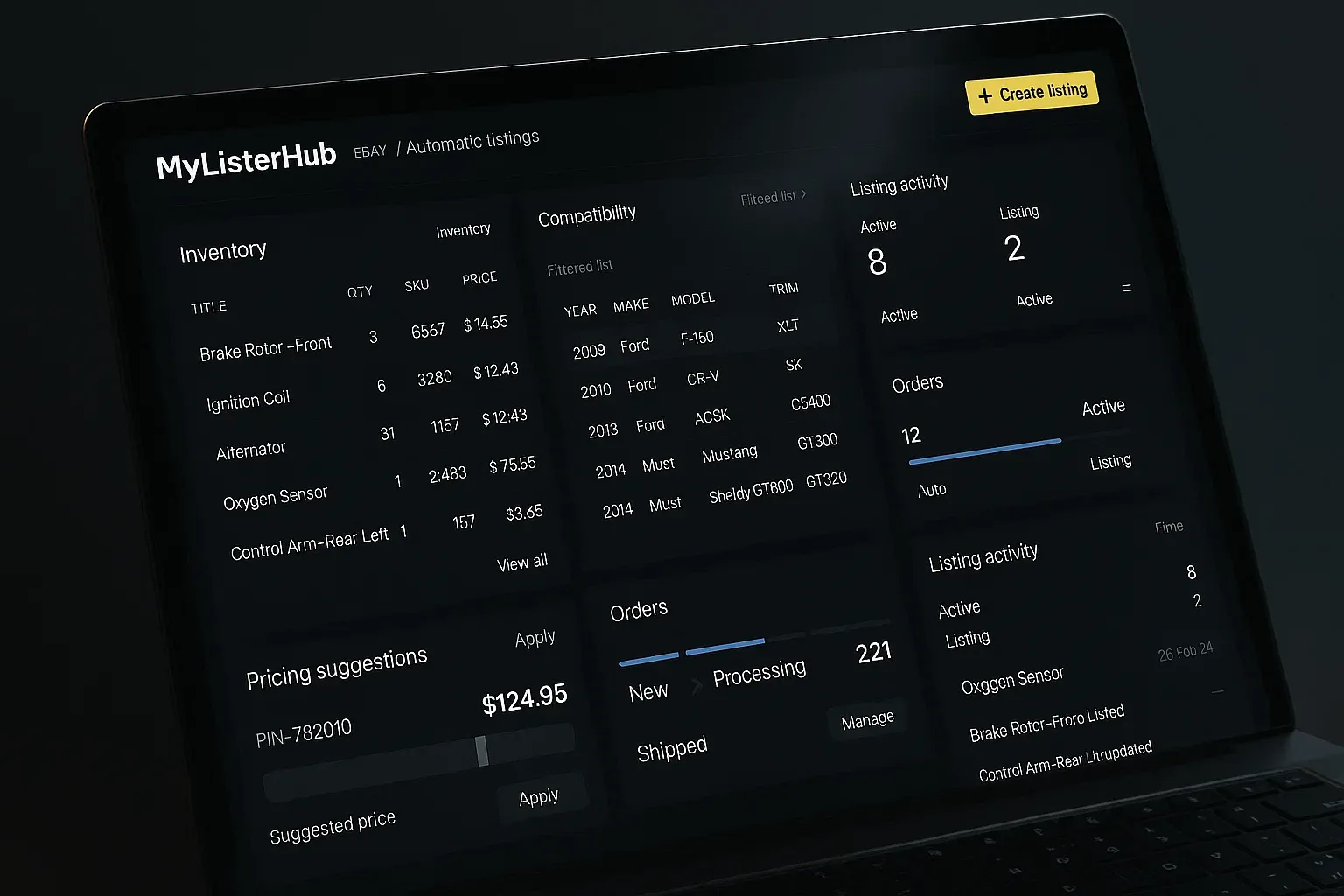
Opening a business account and a basic eBay store can be done in a single day. The real timeline depends on how organized your inventory data is. If you already have a system in place, you can usually export a CSV file and upload it to MyListerHub within a couple of days. All you really need are your images hosted online and a bit of data organization. That is simple work that any data entry person can handle with basic guidance.
If you do not have any database at all and everything is sitting on shelves in boxes, you can still move fast. Take photos of 50 parts at a time with your phone, upload them to MyListerHub, and our AI can generate all the details for you, including titles, descriptions, item specifics, and suggested pricing, then prepare those listings for eBay automatically. In that case, the limiting factor is how quickly you can take pictures, not how fast someone can type.
Which Auto Parts Businesses Should Be On eBay?
If you deal with car parts in any serious way, there is a place for you on eBay. Wholesale distributors with regional accounts can create an additional channel to sell off odd lots, returns, and slower-moving lines. Retail stores with a packed back room can finally turn over the boxes they have dusted three times a year for the last decade. Manufacturers and private label brands can reach end buyers directly and test their products in real-world conditions. Used parts and salvage yards can get engine blocks, transmissions, body panels, and modules in front of buyers across the country instead of relying only on local calls. New parts dealers can move the aging inventory of older models that their local customers no longer request. Aftermarket and performance specialists can connect with niche communities that are not represented in their local town at all. Even dropshippers, when partnered with reliable wholesale sources, can carve out profitable micro niches.
Car parts are the number one selling category on eBay. Whether it is a complete engine block, a bumper cover, a full set of tires, a diagnostic scanner, or a small specialty tool, the odds are extremely high that someone is actively looking for that item on eBay right now. If you fit into any of these categories and you are not yet selling there, you are not just missing an extra channel. You are quietly teaching your potential customers to buy from someone else.
What It Looks Like To Run eBay As An Auto Parts Operation
The idea of getting on eBay feels overwhelming when you imagine listing one part at a time. In reality, an auto parts operation should be approached as a structured project.
The first step is getting your data into shape. You need to know your SKUs, brands, OEM part numbers, and any cross-reference numbers. You should have basic fitment details like make, model, year, engine, and body style, and you need a clear handle on condition: new, used, refurbished, or for parts. If you already use an internal catalog or inventory system, this step involves mapping that data into a format eBay understands. If you do not, the effort you invest here will pay off in every part of your business, not just your eBay channel.
Next, choose the right starting inventory rather than dumping everything online at once. A smart pilot usually focuses on higher margin parts, items that are realistic to ship, and SKUs that are slow or dead locally but have known demand in the broader market. Parts with clear, unambiguous fitment are the best early candidates. This approach lets you learn your own shipping and returns patterns with minimal risk and gives your team time to get used to the workflow.
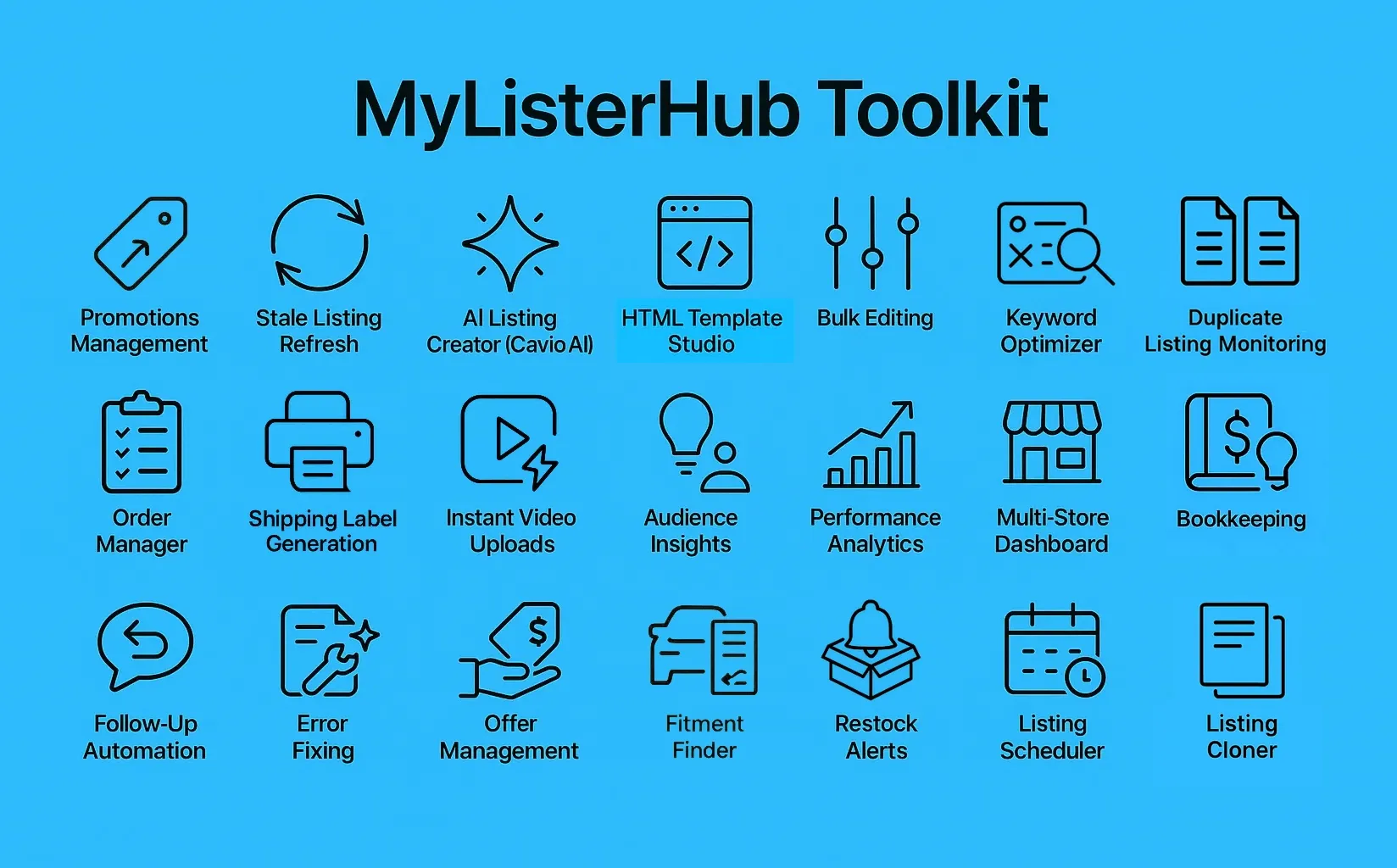
From there, you need listings that actually convert. That means clear, keyword-rich titles that include part numbers, brands, and fitment, plus clean photos that show labels, part numbers, and the actual condition of the part. Item specifics should be filled in accurately and consistently. Condition descriptions should be honest, especially for used or reconditioned items. This is where AI tools like Cavio AI inside MyListerHub become powerful. They can generate strong titles, descriptions, and even price suggestions from photos, then let your team refine and approve those listings in bulk instead of building each listing from scratch.
Once listings are live, you must keep inventory in sync. Overselling a part that your local shop already bought is a quick way to collect negative feedback. A proper setup will synchronize stock between your internal system and eBay, reserve inventory when orders are created, and correctly manage multiple quantity listings. Finally, shipping needs to be standardized. Auto parts shipping involves dimensional weight, creative packaging for heavy metal components, and sometimes hazmat rules for products like batteries and airbags. Once you identify the best packaging methods and carriers for your key categories, you can turn those into repeatable processes your team can follow every day.
All of this might sound like a lot to set up, but in reality, it is simpler than it looks and absolutely worth the effort. The hardest part is not the CSV file, the fitment, or the shipping rules. The hardest part is changing what you are used to and stepping out of your comfort zone. Yes, it is a cliché, but it is the truth. You already handle engines, diagnostics, and complex repairs every day; building a proper eBay channel is much easier than that once you decide to start.
The Fears And Misconceptions That Hold Parts Businesses Back
When owners push back on the idea of selling on eBay, the objections tend to sound very similar. One common fear is that returns will destroy margins. Fitment risk is real, but eBay has invested heavily in tools like its Guaranteed Fit program, where buyers must enter full vehicle details. When you combine that with accurate fitment data and clear listings on your side, you often see returns decrease rather than explode, because buyers have more confidence going in.
Another concern is that fees are too high. Fees matter and should be part of your calculation, but they need to be compared to the cost of dead stock, storage, and eventual write-offs. A part that sells on eBay at a profit after fees and shipping is almost always better than the same part sitting on a shelf for years and then being sold off for pennies. Many sellers discover that eBay becomes their best margin channel for specific, hard-to-find SKUs that simply do not move locally.
Time is another fear. Owners imagine their staff spending hours creating listings one by one. That is not how a serious operation should run. The combination of bulk listing tools, AI-generated content, and automated relisting and pricing means your team becomes more like a control tower and less like a line of data entry clerks. They oversee the process and make decisions, rather than typing the same details all day.
A final misconception is that their parts are too weird and no one will find them online. In practice, those unusual SKUs often perform best on marketplaces. When a vehicle is ten or fifteen years old and the dealer no longer stocks that odd bracket, connector, or module, the mechanic or owner is grateful to pay a fair price to anyone who still has one in stock. On eBay, you can be that seller.
Why eBay Margins Often Work Better Than You Expect
Talking about channels without talking about money is pointless. The good news is that, for many auto parts operations, the math on eBay works out far better than they expect. Take a simple example. You might sell an old bumper locally for 50 dollars just to free up space. If that same bumper sells on eBay for 160 dollars to a buyer three states away, and after fees and shipping, you net 90 dollars, you clearly did more work to get it out the door, but you also made substantially more profit.
When you apply that logic to interior electronics, small trim pieces, sensor clusters, discontinued OEM components, and other niche items, the results compound. These are exactly the types of parts that tend to stagnate in local markets but perform well online. You are leveraging the long tail of demand across an entire country or even multiple countries instead of just your city.
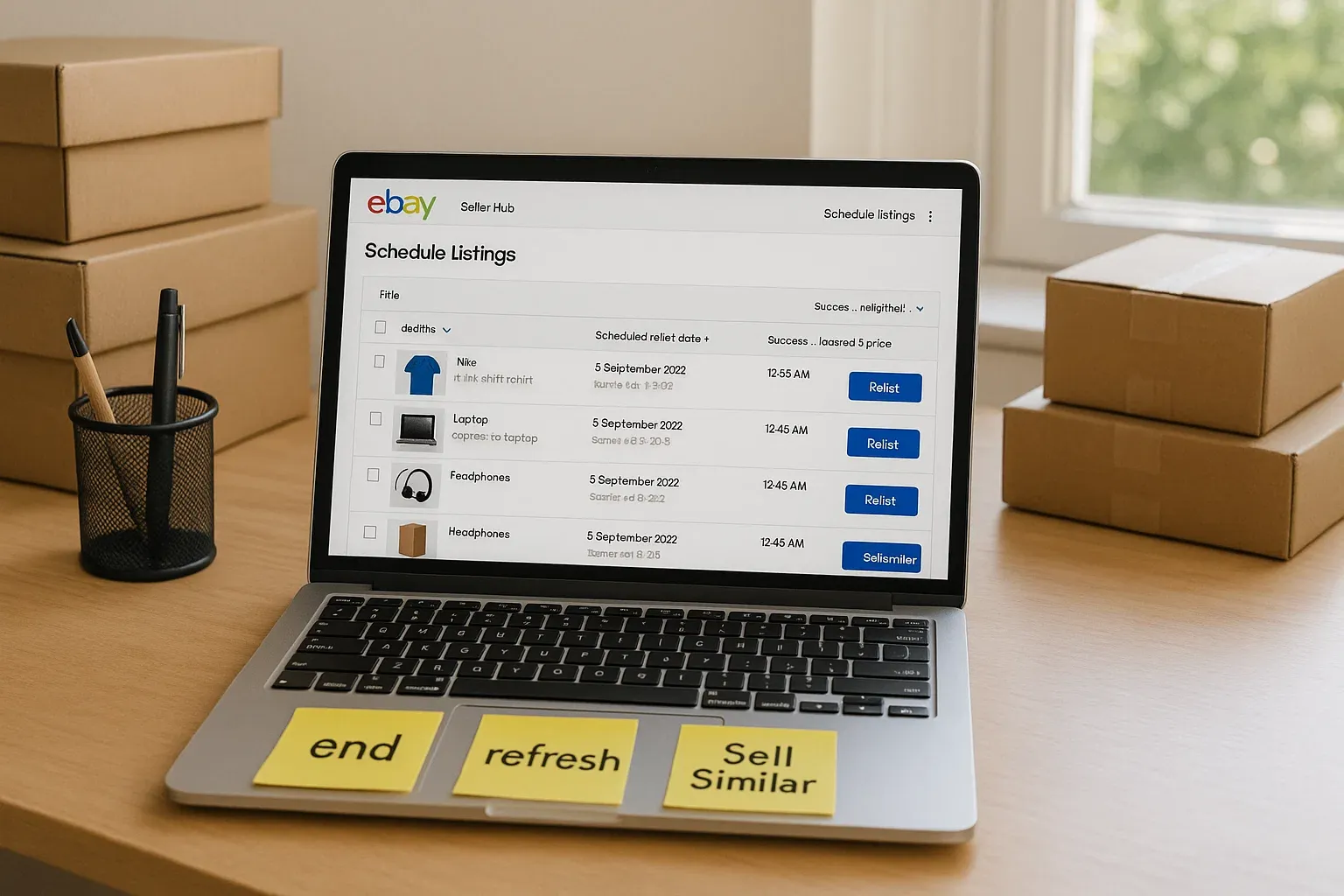
Dynamic pricing and Sell Similar cycles also help protect your margins. Instead of dropping your price to rock bottom and leaving it there, you can test small increases and decreases over time based on real performance. You can keep listings fresh, avoid the stale penalty, and let the market tell you where the ideal selling price really is. If you want a deeper dive on pricing mechanics, the MyListerHub article “How to Price Your eBay Listings for Profit (and When to Adjust)” breaks down formulas, margin structures, and automation options that work across categories, including auto parts.
A Practical Roadmap To Building eBay As A Serious Channel
For an auto parts business, the most innovative approach to eBay is a staged rollout rather than a big bang. In the first month, focus on a pilot. Audit your catalog and choose a manageable group of SKUs, often between 200 and 500 items, that are higher margin, slower-moving locally, and realistic to ship. Build or import solid listings for these parts with correct fitment, honest condition descriptions, and reliable shipping profiles. Get inventory sync and basic policies in place before chasing big volume. A useful companion piece at this stage is “The Best Automation Strategies for eBay Sellers in 2024” which explains how to reduce the manual workload that usually scares owners away.
In months two and three, expand and stabilize. Add more SKUs in batches, refine your shipping rules based on actual carrier performance, and pay attention to which part types move fastest and which offer the best margins. Start using automated relisting or Sell Similar strategies to keep your store looking active, rather than letting listings sit dead for months. The MyListerHub blog article “Optimize Stale Listings on eBay: Proven Tips to Boost Visibility and Sales” is particularly relevant here.
From month four onward, you can start layering in more advanced automation and AI. Use image-based listing tools so your team can create listings from photos and part numbers, not just from spreadsheets. Turn on automated offer rules to ensure buyers get quick responses, and configure message sequences and feedback follow-ups to keep customers engaged without requiring manual typing each time. Implement dynamic pricing so selected SKUs automatically adjust based on rules you define, rather than remaining static for years. Resources like “Why Every eBay Seller Needs a Smart Pricing Tool”.
If You Do Not Have An eBay Store Yet, Start Here
The easiest starting point is simply opening a business account and a store on eBay. Go to ebay.com, create a business account with your company details, and choose a store level that matches your near-term goals. You can always upgrade as your volume grows. Set your core policies, including handling time, return conditions, and shipping options, so buyers know what to expect.
Once your basic presence is set up, create a small test batch of listings for maybe 20 to 50 items. Use this batch to validate your process, not to maximize revenue. You want to see whether your data flows correctly, your team can handle orders and messages, and your packaging stands up to real shipments. You do not need perfection on day one. You need a real proof of concept that shows you that strangers are willing to buy from you, that eBay can bring in orders you never would have seen otherwise, and that your staff can handle this channel without burning out. After that, the question stops being whether you should be on eBay and becomes how quickly you can bring the rest of your catalog online in a controlled way.
Where AI And Automation Are Taking The Parts Industry Next
On the operations side, systems like MyListerHub’s Cavio AI are already turning raw product content and images into full eBay listings with titles, descriptions, prices, and item specifics. Automation can already handle stale listing management, periodic price changes, messaging sequences, and more. Each year you wait has a real cost. Your competitors build stronger feedback profiles and deeper sales histories. Their stores occupy more of the trusted seller space in buyers’ minds. Your aging inventory gets older, and the window to move it at a healthy price narrows.
Too many junkyards and parts sellers are discovering this reality only when they are forced to close, selling years of inventory for cents on the dollar. You do not have to be one of them. The path to survival and growth is not to abandon what you know. It is to connect what you know, the vehicles, the part numbers, the failure patterns, the cross references, to the digital channels where demand is now concentrated.
Bringing It All Together
Your auto parts business has already done the hard work. You have invested in space, racking, staff, purchasing decisions, and inventory systems. You know which parts are rare, which numbers have history, and which components keep older vehicles alive when everyone else says “no longer available.” eBay gives you the missing half of that equation: direct access to the buyers who are actively searching for those exact parts every hour of every day.
In 2025, with automotive as eBay’s number one category and AI-driven discovery already shaping who gets seen, not being on eBay is no longer a neutral choice. It is a decision to let other sellers build relationships with your potential customers and to let your own inventory age in silence. The real choice in front of you is simple. You can become the auto parts business that adapts early, learns this channel, and turns old stock into new profit. Or you can become the one who watches others scoop up your market while you eventually liquidate for pennies on the dollar.
It's time to place your SKUs where buyers are looking: on eBay.
Coming Soon: Our Fitment Tool is Built for Real eBay Motors Workflows
We’re putting the final touches on our next-generation fitment and compatibility engine for eBay auto parts sellers. It’s built to do what current tools don’t: make fitment data transparent, easy to correct, and directly tied to your listings, returns, and pricing strategy.
This feature will roll out in Q1 of 2026. For now, it’s only available to a limited group of beta users who are helping us stress-test coverage and workflows on real catalogs.
If you want to be early in line, book a demo and tell us you’d like to join the beta waiting list. We’ll review your eBay store and, if it’s a good match, reserve your spot as we open more beta seats.
Popular articles

ALL-IN-ONE
SHOULD REALLY MEAN
ALL-IN-ONE!
Orders, Offers, Messages, Chat, SMS, Listings, Inventory, AI, Automation, Syncing, Shipping, Customization, Analytics, Bookkeeping & Accounting, Template Designer, CRM, and a lot more.