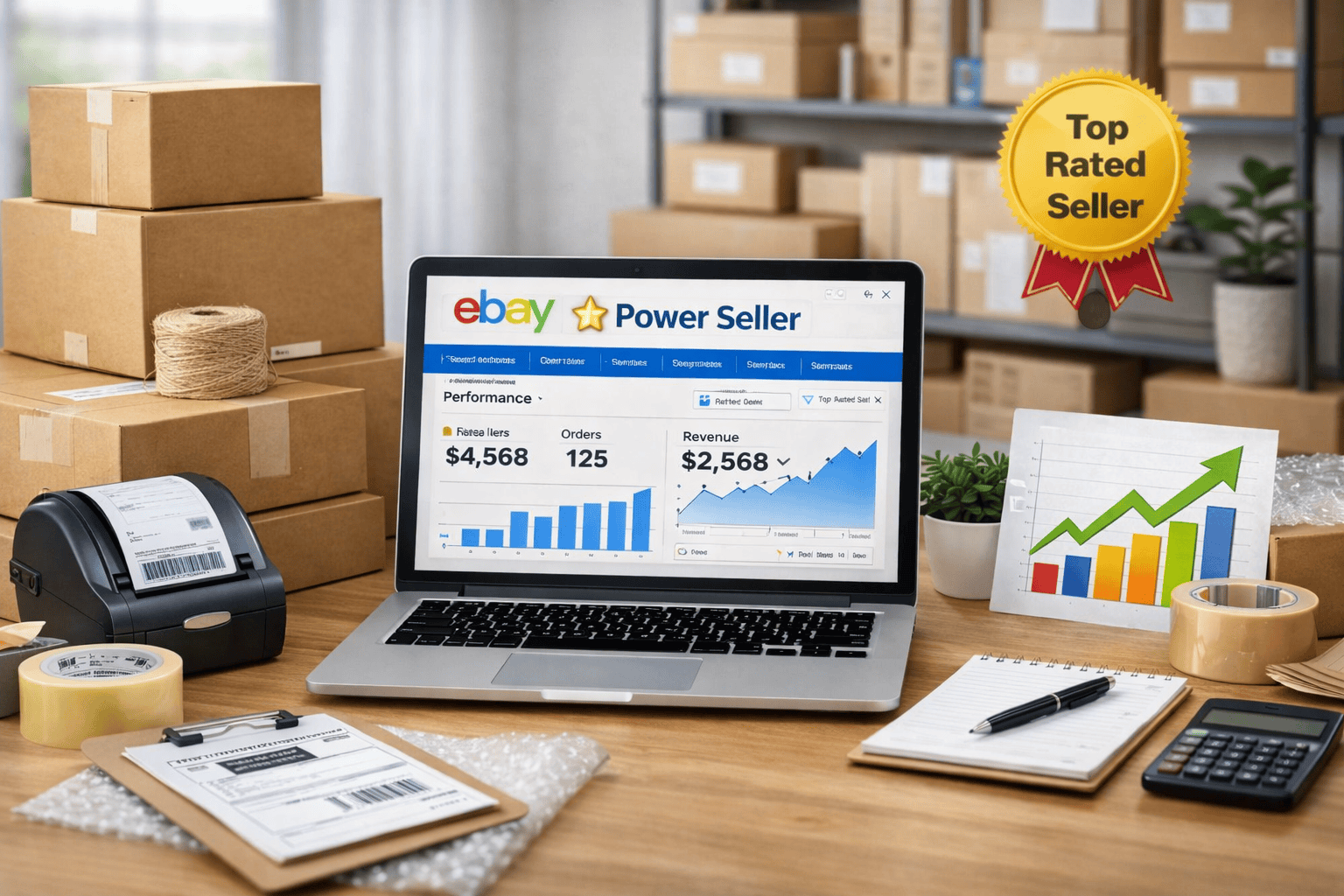
eBay Power Seller Requirements & Benefits (2026 Guide)
Learn eBay Power Seller requirements, benefits, and how sellers qualify. Discover how Power Seller standards help you rank, sell more, and scale.

Updated Feb 13, 2026
|Omri Ross
eBay Power Seller vs Top Rated Seller in 2026: Requirements and Advantages Compared
Becoming an eBay Power Seller has long been a major milestone for sellers who want to be recognized as trusted, high-performing professionals on the platform. While eBay has evolved its seller programs over the years, Power Seller standards still represent what it takes to succeed at a high level.
In this guide, we break down eBay Power Seller requirements, explain the real benefits of reaching Power Seller-level performance, and show exactly how sellers can qualify and scale their eBay business in today’s competitive marketplace.
What Is an eBay Power Seller?
The eBay Power Seller program was originally created to recognize sellers who consistently delivered strong sales volume, excellent customer service, and reliable fulfillment. Power Sellers were viewed as established, professional sellers who met strict performance benchmarks.
Although eBay now emphasizes the Top Rated Seller program, the concept of a Power Seller still matters. Many sellers and buyers continue to associate the term “Power Seller” with experience, trust, and authority. In practice, sellers who meet Power Seller-level performance today are usually the same sellers who qualify for Top Rated Seller status.
Why eBay Created the Power Seller Program
eBay’s success depends heavily on buyer trust. The Power Seller program was designed to reward sellers who helped build that trust through consistent performance.
The program encouraged sellers to ship on time, communicate clearly, maintain high feedback scores, and scale responsibly. These goals are still deeply embedded in how eBay ranks listings and evaluates seller accounts today.
eBay Power Seller Requirements Explained
While eBay no longer promotes the Power Seller badge as it once did, the original requirements still reflect what eBay values most.
Typical Power Seller requirements included:
- An active eBay account for at least 90 days
- At least 100 completed transactions within the past 12 months
- A minimum of $3,000 in annual sales volume
- A feedback score of 98 percent positive or higher
- Strong compliance with eBay seller policies
- Low defect rates and reliable shipping performance
Sellers who consistently meet or exceed these benchmarks are effectively operating at a Power Seller level, regardless of how eBay labels them publicly.
eBay Seller Levels and Power Seller Tiers
Historically, eBay Power Sellers were divided into tiers based on annual sales volume. These tiers included Bronze, Silver, Gold, Platinum, and Titanium Power Sellers.
Each tier represented increased sales volume and operational scale. While these tiers are no longer displayed the same way, the concept still influences how eBay evaluates seller authority behind the scenes.
Power Seller vs Top Rated Seller: What’s the Difference?
Many sellers wonder whether Power Seller status still matters now that eBay promotes the Top Rated Seller program.
The reality is that Top Rated Seller is the modern evolution of the Power Seller program. Sellers who meet Power Seller-level standards almost always qualify for Top Rated Seller status as well.
To become a Top Rated Seller, sellers must meet requirements such as:
- At least 100 transactions and $1,000 in sales with U.S. buyers
- Low defect rates
- Fast handling times and valid tracking uploads
- Excellent buyer satisfaction metrics
Top Rated Sellers receive algorithmic advantages that mirror and often exceed the benefits Power Sellers received in the past.
eBay Power Seller Benefits
Reaching Power Seller-level performance unlocks several meaningful advantages that directly impact sales and growth.
Increased Buyer Trust
Buyers feel more confident purchasing from sellers with proven performance. High feedback scores and consistent service reduce hesitation and increase conversion rates.
Better Search Visibility
eBay rewards reliable sellers with improved placement in search results. Listings from strong sellers are more likely to appear higher for competitive keywords.
Fee Discounts and Promotions
Top-performing sellers may qualify for final value fee discounts and better performance when using promoted listings.
Stronger Seller Protections
Sellers with strong metrics receive added protection in disputes, returns, and chargebacks, reducing risk as order volume increases.
Easier Business Scaling
Once a seller reaches Power Seller-level standards, scaling becomes easier. Increased visibility leads to more sales, which strengthens account authority and long-term performance.
How to Become an eBay Power Seller Today
To operate at a Power Seller level in today’s eBay ecosystem, sellers should focus on building strong systems rather than chasing shortcuts.
Key areas to prioritize include:
- Consistent listing activity
- Fast and accurate shipping
- Clear, honest product descriptions
- Professional buyer communication
- Organized inventory management
- Low return and defect rates
Power Seller success comes from consistency and operational discipline over time.
Why Power Seller Standards Matter Long-Term
eBay’s algorithm rewards reliability. Sellers who consistently meet Power Seller benchmarks signal trustworthiness to both buyers and eBay’s ranking systems.
This creates a powerful compounding effect:
- Higher trust leads to better rankings
- Better rankings lead to more sales
- More sales lead to stronger account authority
Over time, this momentum separates serious sellers from casual sellers.
Even as eBay modernizes its seller programs, Power Seller requirements remain one of the clearest blueprints for success on the platform.
Sellers who operate at this level benefit from stronger visibility, higher conversion rates, better protections, and long-term scalability. Whether your goal is Top Rated Seller status or building a full-time eBay business, Power Seller standards remain the foundation for sustained growth.
Popular articles

ALL-IN-ONE
SHOULD REALLY MEAN
ALL-IN-ONE!
Orders, Offers, Messages, Chat, SMS, Listings, Inventory, AI, Automation, Syncing, Shipping, Customization, Analytics, Bookkeeping & Accounting, Template Designer, CRM, and a lot more.